 , a fancy photo sharing thing.
Thursday, December 17, 2009

Sunday, November 22, 2009
Saturday, November 21, 2009
Scottish Re Posts to Its Website Third Quarter 2009 Financial Statements
Business
© Business Wire 2009
Scottish Re Posts to Its Website Third Quarter 2009 Financial Statements
 | Print article |
 | Refer to a friend |
2009-11-20 22:09:02 -
diluted ordinary share, as compared to a net loss attributable to ordinary shareholders of $713.9 million, or ($10.44) per diluted ordinary share, for the prior year period. The net income attributable to ordinary shareholders for the three month period ended September 30, 2009 was driven by net realized and unrealized gains of $191.1 million resulting from an overall market recovery of fixed maturity investments, as compared to net realized and unrealized losses of $475.4 million for the prior year period.
To view the financial statement documents go to Scottish Re's website at www.scottishre.com : .
.
About Scottish Re
Scottish Re Group Limited is a global life reinsurance specialist.
Scottish Re has operating businesses in Bermuda, Ireland and the United States. Its flagship operating subsidiaries include Scottish Annuity & Life Insurance Company (Cayman) Ltd., and Scottish Re (U.S.), Inc.
Additional information about Scottish Re Group Limited can be obtained from its website, www.scottishre.com : .
Scottish Re Group LimitedMedia and Investor Contact:Paul
Goldean, Chief Executive Officer, 441-298-4378
Scottish Re Group Limited (Pink Sheets: SKRRF) "Scottish Re" or the "Company", announced today that it has posted to its website its unaudited consolidated financial statements for the three and nine months ended September 30, 2009. For the three month period ended September 30, 2009, Scottish Re reported net income attributable to ordinary shareholders of $201.9 million, or $0.92 per
| |
To view the financial statement documents go to Scottish Re's website at www.scottishre.com :
.About Scottish Re
Scottish Re Group Limited is a global life reinsurance specialist.
Scottish Re has operating businesses in Bermuda, Ireland and the United States. Its flagship operating subsidiaries include Scottish Annuity & Life Insurance Company (Cayman) Ltd., and Scottish Re (U.S.), Inc.
Additional information about Scottish Re Group Limited can be obtained from its website, www.scottishre.com :
.Scottish Re Group LimitedMedia and Investor Contact:Paul
Goldean, Chief Executive Officer, 441-298-4378
Champion Enterprises Files for Chapter 11 to Restructure Debt
Champion Enterprises Files for Chapter 11 to Restructure Debt
--- Obtains $40 Million New Credit Facility--- Operations to Continue During Restructuring Process--- International Operations Excluded from Filing
TROY, Mich., Nov 15, 2009 /PRNewswire-FirstCall via COMTEX/ -- Champion Enterprises, Inc. (NYSE: CHB), a leader in factory-built construction, today announced that it and its domestic operating subsidiaries filed voluntary petitions for reorganization under Chapter 11 of the U.S. Bankruptcy Code. The Company is taking this action to improve its capital structure and further strengthen its competitive position. The Company's operations in the United Kingdom and Canada were not included in and will not be impacted by the filing.
In conjunction with the filing, the Company has obtained a $40 million debtor-in-possession (DIP) credit facility from certain of its current lenders that will be available to fund post-petition operating expenses and to ensure that it continues to meet its obligations to employees, customers, and trade partners. A portion of these funds will be available for use outside the U.S. to ensure the continued adequacy of working capital for the Company's non-U.S. operations.
The Company expects that this restructuring will be accomplished through a court-supervised sale of its operations. The Company chose to pursue a broader sale process in which its lenders and others may participate after opting not to accept a third party offer for the Company. To that end, the Company's investment banker has already received initial indications of interest from a number of parties expressing a desire to participate in this sale process over the coming weeks.
"Our Company has operated for many years with a significant debt load. As we've had to downsize to keep up with the declining markets, this debt has become increasingly burdensome," said Champion Chairman, President and Chief Executive Officer William C. Griffiths. "Despite our best efforts to reposition the company for diversified growth, the continued challenging economic conditions both here and abroad have negatively impacted our capacity for debt.
"As a result, management and the Board decided that the Chapter 11 process provides us with the most timely and orderly means to restructure our debt obligations and facilitate a sale and recapitalization of the Company so we can be best positioned to capitalize on future opportunities. Filing for Chapter 11 will allow us to maintain our going concern value for the benefit of our stakeholders while we address current market realities."
Mr. Griffiths noted that in response to the challenging housing market and impaired capital markets, Champion has already successfully implemented a number of initiatives aimed at improving operating performance, including the reduction of overhead costs, closure or idling of 15 underperforming manufacturing facilities in the U.S. since mid-2006, staff reductions at operating plants to better match current demand levels, increased focus on multi-family, military and commercial sales opportunities and enhancement of single-family home product offerings.
"Our balance sheet is the problem, not our operations. The next step in our reorganization is to restructure our balance sheet and position our company to capitalize on the anticipated recovery in the residential and commercial construction markets," said Mr. Griffiths.
The Company emphasized that daily operations are expected to continue throughout the restructuring. The Company filed nearly 20 "first-day motions" covering the continuation of employees and business operations, as well as post-petition DIP financing, the continuation of supplier payments, customer warranty programs and retailer rebate programs, and other case administration matters. The Company anticipates that these first-day motions will be heard this week. Pursuant to the relief requested in those motions, homes will be sold, manufactured and delivered as normal and employees will be paid and continue to receive the same benefits as before the filing.
"Despite the current challenges in our core markets, we still believe there are considerable opportunities in the factory-built construction industry in the future," said Mr. Griffiths. "Addressing our liabilities through the Company's bankruptcy filing is the last step in a comprehensive restructuring we began some time ago. We fully expect to proceed through this restructuring swiftly and with the strong support of our lenders. Throughout the process we will continue designing and manufacturing high quality products for our retailers, builders and developers."
The Company filed its voluntary petitions in the U.S. Bankruptcy Court for the District of Delaware in Wilmington.
For further information please contact the Company's information line at (877) 857-7554 or (248) 614-8390 for international callers, which is staffed live Monday to Friday between 8 am and 6 pm eastern standard time or visit the Company's restructuring website at www.championrestructures.com.
About Champion
Troy, Michigan-based Champion Enterprises, Inc., a leader in factory-built construction, operates 27 manufacturing facilities in North America and the United Kingdom distributing its products through independent retailers, builders and developers. The Champion family of builders produces manufactured and modular homes, as well as modular buildings for government and commercial applications. For more information, please visit www.championhomes.com.
http://www.pinksheets.com/pink/quote/quote.jsp?symbol=CJHBQ#getNews
--- Obtains $40 Million New Credit Facility--- Operations to Continue During Restructuring Process--- International Operations Excluded from Filing
TROY, Mich., Nov 15, 2009 /PRNewswire-FirstCall via COMTEX/ -- Champion Enterprises, Inc. (NYSE: CHB), a leader in factory-built construction, today announced that it and its domestic operating subsidiaries filed voluntary petitions for reorganization under Chapter 11 of the U.S. Bankruptcy Code. The Company is taking this action to improve its capital structure and further strengthen its competitive position. The Company's operations in the United Kingdom and Canada were not included in and will not be impacted by the filing.
In conjunction with the filing, the Company has obtained a $40 million debtor-in-possession (DIP) credit facility from certain of its current lenders that will be available to fund post-petition operating expenses and to ensure that it continues to meet its obligations to employees, customers, and trade partners. A portion of these funds will be available for use outside the U.S. to ensure the continued adequacy of working capital for the Company's non-U.S. operations.
The Company expects that this restructuring will be accomplished through a court-supervised sale of its operations. The Company chose to pursue a broader sale process in which its lenders and others may participate after opting not to accept a third party offer for the Company. To that end, the Company's investment banker has already received initial indications of interest from a number of parties expressing a desire to participate in this sale process over the coming weeks.
"Our Company has operated for many years with a significant debt load. As we've had to downsize to keep up with the declining markets, this debt has become increasingly burdensome," said Champion Chairman, President and Chief Executive Officer William C. Griffiths. "Despite our best efforts to reposition the company for diversified growth, the continued challenging economic conditions both here and abroad have negatively impacted our capacity for debt.
"As a result, management and the Board decided that the Chapter 11 process provides us with the most timely and orderly means to restructure our debt obligations and facilitate a sale and recapitalization of the Company so we can be best positioned to capitalize on future opportunities. Filing for Chapter 11 will allow us to maintain our going concern value for the benefit of our stakeholders while we address current market realities."
Mr. Griffiths noted that in response to the challenging housing market and impaired capital markets, Champion has already successfully implemented a number of initiatives aimed at improving operating performance, including the reduction of overhead costs, closure or idling of 15 underperforming manufacturing facilities in the U.S. since mid-2006, staff reductions at operating plants to better match current demand levels, increased focus on multi-family, military and commercial sales opportunities and enhancement of single-family home product offerings.
"Our balance sheet is the problem, not our operations. The next step in our reorganization is to restructure our balance sheet and position our company to capitalize on the anticipated recovery in the residential and commercial construction markets," said Mr. Griffiths.
The Company emphasized that daily operations are expected to continue throughout the restructuring. The Company filed nearly 20 "first-day motions" covering the continuation of employees and business operations, as well as post-petition DIP financing, the continuation of supplier payments, customer warranty programs and retailer rebate programs, and other case administration matters. The Company anticipates that these first-day motions will be heard this week. Pursuant to the relief requested in those motions, homes will be sold, manufactured and delivered as normal and employees will be paid and continue to receive the same benefits as before the filing.
"Despite the current challenges in our core markets, we still believe there are considerable opportunities in the factory-built construction industry in the future," said Mr. Griffiths. "Addressing our liabilities through the Company's bankruptcy filing is the last step in a comprehensive restructuring we began some time ago. We fully expect to proceed through this restructuring swiftly and with the strong support of our lenders. Throughout the process we will continue designing and manufacturing high quality products for our retailers, builders and developers."
The Company filed its voluntary petitions in the U.S. Bankruptcy Court for the District of Delaware in Wilmington.
For further information please contact the Company's information line at (877) 857-7554 or (248) 614-8390 for international callers, which is staffed live Monday to Friday between 8 am and 6 pm eastern standard time or visit the Company's restructuring website at www.championrestructures.com.
About Champion
Troy, Michigan-based Champion Enterprises, Inc., a leader in factory-built construction, operates 27 manufacturing facilities in North America and the United Kingdom distributing its products through independent retailers, builders and developers. The Champion family of builders produces manufactured and modular homes, as well as modular buildings for government and commercial applications. For more information, please visit www.championhomes.com.
http://www.pinksheets.com/pink/quote/quote.jsp?symbol=CJHBQ#getNews
Sunday, November 15, 2009
Chemtura Corporation Institutional Holdings

The above chart is provided by AOL Finance. More info can be found at the link below.
http://finance.aol.com/company/chemtura-corp/cemjq/nao/institutional-ownership


ICC Capital Management Still Holding Shares of Chemtura
ICC Capital Management still holds a significant portion of equity of Chemtura Corporation. According to the MFFAIS website, ICC still holds all 21,961,432 shares of Chemtura equity. It was reported on 11/09/09 and current as of 9/30/09.
http://www.mffais.com/cem
Follow the money. ICC is still holding. SVP is holding. Although the weekly chart is looking a little bit bearish from the recent run-up to $1.48, Chemtura's recent MOR - Monthly Operating Report - showed that cash is up and book value is up to 1.47.
Montly Operating Reports are a barometer to measure a company's financial activity while in the Chapter 11 Reorganization Process.
The last quarterly report combined with this latest MOR is showing Chemtura's positive shareholder value.
http://www.mffais.com/cem
Follow the money. ICC is still holding. SVP is holding. Although the weekly chart is looking a little bit bearish from the recent run-up to $1.48, Chemtura's recent MOR - Monthly Operating Report - showed that cash is up and book value is up to 1.47.
Montly Operating Reports are a barometer to measure a company's financial activity while in the Chapter 11 Reorganization Process.
The last quarterly report combined with this latest MOR is showing Chemtura's positive shareholder value.
Tuesday, November 3, 2009
CEMJQ - Possible Hint In Court Docs


Take note to section 4:
"Since filing the Declaration, the Firm has been retained by a potential purchaser of certain assets of the Debtors (the "Potential Purchaser") to provide transaction-related advice with respect to the Potential Purchaser's potential acquisition of certain assets of the Debtors."
...they used and repeated the term "Potential Purchaser" 3 times here folks...Something "potentially" is on the horizon here...stay tuned folks...
PS...The US Trustee has asked K&E to come clean according to a letter she sent out to members of the Chemtura Stock Alliance...definitely stay tuned folks...

CEMJQ - Falling Wedge Pattern


Okay kids, the CEMJQ chart continues to consolidate, and let's take a little deeper look into what it is telling us.
Since we have peaked at 1.48 a lil' ole pattern has developed here...and it's called a falling wedge pattern...A little info on it below...
Falling Wedge: We are currently trading in a falling wedge pattern, which is a pattern that develops within a bullish trading pattern or uptrend. This trading channel is a form of consolidation, and once it has finished forming the wedge, look for it to break out to the upside of the top of the channel. The more it touches each channel the stronger it becomes in regard to the breakout move.
The chart indicates a couple areas of support beyond the 55ema at .89. I've drawn a couple of support lines that were once resistance lines if you look at the left side of the chart.
I bet you are asking yourself, why in the hell is this happening? Well, not all stocks can go straight up, unless you are VRMLQ or DNDN!!! Those are some fun charts to look at.
It's healthy for real up-trends to have these rounds of consolidations. What causes them? Easy. Profit-takers and traders. Traders saw that 1.50 was the key resistance on the chart during the recent uptrend, and started taking profits, and others decided that they didn't want to sit in this stock for too long.
Investopedia Definition of Wedge:
Wedge

What Does Wedge Mean?
A technical chart pattern composed of two converging lines connecting a series of peaks and troughs.
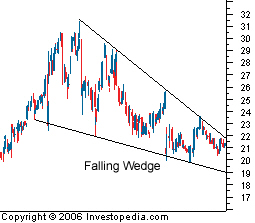
A technical chart pattern composed of two converging lines connecting a series of peaks and troughs.


Falling wedges indicate temporary interruptions of upward price rallies. Rising wedges indicate interruptions of a falling price trend. Technical analysts see a 'breakout' of this wedge pattern as either bullish (on a breakout above the upper line) or bearish (on a breakout below the lower line)
Monday, November 2, 2009
CEMJQ Chart Analysis - DAY 12 of Current Consolidation Period

Okay folks, Cemjq closed today at .94 on anemic volume. We saw 733,597 in volume toay, Nov. 2, 2009, and it was about even with around 313,153 buys versus 393,091 sells. So we had a slight red inverted hammer form today. Let's take a closer look at the what these indicators are telling us.
The RSI (14) is at 45.74, and it has not been this low or even below 50 since July 2009, which was the tail end of the longest consolidation period post bankruptcy trading for Chemtura. It was sub 50 before CEMJQ started flexing on the markets during its prolonged consolidation period of @ 35 trading days, give or take a couple.
The MACD indicator is closing in on 0.00, and it hasn't been near this level since June/July of 2009 during that protracted consolidation period.
The full stochastics are below 20 for the first time since that same 35+ consolidation period back in late June.
The CCI (20) is nearing -100, and it has not been this low since that June/July consolidation period.
The PPO Oscillator is nearing 0 again, and again we haven't seen it this low since July 2009 during that big consolidation period.
Many of these indicators are extremely oversold, and the volume is thinning on this pullback, which could be setting the table for Chemtura's Next Monster Run. Although I feel we could be in for another big round of consolidation, which we are currently in the midst of here, I do believe good news has been hitting Chemtura's table and, in my opinion, it is being set for bigger moves ahead.
Longacre Opportunity Fund, L.P. Acquiring Chemtura's Debt
Longacre Opportunity Fund, L.P., has been acquiring Chemtura's debt recently. They have gobbled up over $600,000 in debt and could still be acquiring more. Recent filings at http://www.kccllc.net/chemtura show public record of Longacre acquiring the debt of Chemtura from other creditors.
They state that they hold onto their investments from bankrupt companies for a time period of 6 months to 2 years. Distressed Asset Management is big money, folks. They know something and see Chemtura will be good for the money, otherwise they would not be buying.
Here is their investment strategy taken directly from their website at
http://www.longacrellc.com/investment.html
They state that they hold onto their investments from bankrupt companies for a time period of 6 months to 2 years. Distressed Asset Management is big money, folks. They know something and see Chemtura will be good for the money, otherwise they would not be buying.
Here is their investment strategy taken directly from their website at
http://www.longacrellc.com/investment.html
 |  | |||||||||
 |  | | ||||||||
 |  |  |  |  |  | | ||||
 | | |||||||||
INVESTMENT MANAGEMENT | | |||||||||
| ||||||||||
Sunday, November 1, 2009
What is Price to Book Multiple and how does it relate to Chemtura?
What Does Price-To-Book Ratio - P/B Ratio Mean?
A ratio used to compare a stock's market value to its book value. It is calculated by dividing the current closing price of the stock by the latest quarter's book value per share.
Also known as the "price-equity ratio".
Calculated as:

A ratio used to compare a stock's market value to its book value. It is calculated by dividing the current closing price of the stock by the latest quarter's book value per share.
Also known as the "price-equity ratio".
Calculated as:
Investopedia explains Price-To-Book Ratio - P/B Ratio
A lower P/B ratio could mean that the stock is undervalued. However, it could also mean that something is fundamentally wrong with the company. As with most ratios, be aware that this varies by industry.
This ratio also gives some idea of whether you're paying too much for what would be left if the company went bankrupt immediately.
CEMJQ CLOSING PRICE 10/30/09 = .96
CEMJQ BV BASED ON 3RD QUARTER RESULTS = $1.42 (PRICE ESTABLISHED IN PREVIOUS POST)
PRICE-TO-BOOK RATIO = .96/1.42 = .68
.68 PB RATIO = BUY NOW BECAUSE CEMJQ IS A BARGAIN ACCORDING TO THE PB RATIO.
A lower P/B ratio could mean that the stock is undervalued. However, it could also mean that something is fundamentally wrong with the company. As with most ratios, be aware that this varies by industry.
This ratio also gives some idea of whether you're paying too much for what would be left if the company went bankrupt immediately.
CEMJQ CLOSING PRICE 10/30/09 = .96
CEMJQ BV BASED ON 3RD QUARTER RESULTS = $1.42 (PRICE ESTABLISHED IN PREVIOUS POST)
PRICE-TO-BOOK RATIO = .96/1.42 = .68
.68 PB RATIO = BUY NOW BECAUSE CEMJQ IS A BARGAIN ACCORDING TO THE PB RATIO.
Thursday, October 29, 2009
Rundown of CEMJQ Trading Today...

Traders took it to the 7ema today at 1.03 on the 3mos daily...bounced it right off of it...like clockwork here folks...lid's gonna come off at some point...matter of time...BV - book value up...one of many positives coming off that 3rd quarter report plus everything else going on here fundamentally looking good imo...nothing FUNDAMENTALLY HAS CHANGED - IF ANYTHING, FUNDAMENTALS ARE GETTING BETTER/STRONGER...it's the TECHNICALS we are battling here...This is a long battle...if the FUNDAMENTALS PROVE TO BE TRUE, THEY ARE GOING TO CRUSH THE TECHNICALS...
ARE YOU GONNA LET THE TECHNICALS KNOCK YOU OUT WHEN THE FUNDAMENTALS ARE REALLY WINNING THIS FIGHT?
CEMJQ Third Quarter Results 2009 - During Chapter 11
Okay folks, I'm gonna keep it real here. We had one helluva ride the past couple of weeks in the markets. Let's try to make sense of it how it relates to Chemtura Corporation. We saw Chemtura have a pullback from it's Post Bankruptcy high of 1.48 back on October 15th. The bears took control after that doji formed on the daily chart on the 15th, and it hit the top of it's trading channel. A quick look at the weekly chart will show an investor that the 1.50 region presented strong resistance, not only for it being the top of the trading channel, but prior to bankrupcty, the 1.50 region was a sideways trading channel for some time prior to Chemtura falling off the cliff when it was obvious they were headed into bankruptcy earlier this year. Now, the bears took over after hitting 1.48, and Chemtura has yet to recover from that pullback. The bears took it below it's trading channel to the .98 region, then a couple of bullish days took it to 1.17, but it came right back down on some low volume. It touched down in the .89 arena which served as support - the 34 ema was sitting right there, and I have conjectured that the 21 million share purchase by SVP at average cost of around .90 per share, would serve as good support. Well, we shall see if this is true, but the good news is that Chemtura's 3-Q results came in today, and they were mighty tasty for a company in bankruptcy. This spurned some buyers coming back into the picture and the price topped out today, Oct. 29th at 1.03 and closed @ .96 pps. I was not at my computer today, so I could not watch the tape, but I'm sure that the market makers are trying to keep a lid on Chemtura for more big money to accumulate, but how long can this go on? It might be hard because we have some nice numbers in the 3rd Quarter Filing. Here are some Highlights:
Consolidated Statements of Operations (Unaudited):
(In millions, except per share data.)
Net Earnings (Loss): 8
Net Earnings per share: .03
------------------------------------------------------------------------------
Balance Sheet Highlights (in millions):
Total Current Assets = 1454
Total NonCurrent Assets = 1670
Total Assets = 3,124
(Total Assets = Total Current Assets + Total Non-Current Assets)
Total Current Liabilities = 647
Total Non-Current Liabilities = 339
Total Liabilities Subject to Compromise = 1,793
(Total Liabilities Subject to Compromise = Total Current Liabilities + Total Non-Current Liabilities)
Total Liabilities not subject to compromise: 986
Total Liabilities: 986 + 1793 = 2779
(Total Liabilities = Total Liabilities not subject to compromise + Total Liabilities subject to compromise)
Total Chemtura Stockholder Equity = 3124 - 2779 = 345
(Stockholder Equity = Total Assets - Total Liabilities)
Segment Net Sales and Operating Profit (Loss) (Unaudited):
(In millions)
Total Sales: 681
Consumer Performance Products = 115
Industrial Performance Products = 271
Crop Protection Engineered Products = 89
Industrial Engineered Products = 206
Operating Profit (Loss): 61
Consumer Performance Products = 17
Industrial Performance Products = 29
Crop Protection Engineered Products = 5
Industrial Engineered Products = 10
General corporate expense, including amortization: (27)
***Impairment Of Long-Lived Assets: 0 (This is big here folks. Huge impairment charges taken in previous quarters, and none here...lookin' good)****
Total Operating Profit (Loss): 34
(Total Operating Profit = Total Operating Profit - General Corporate Expense)
Book Value = Assets - Liabilities / Equity
Book Value = 3124 - 2779 / 242.9 = 345 / 242.9
Book Value = 1.42
Chemtura closed trading today as mentioned earlier at .96. Still a bargain in my book, but the market makers are gonna try to scare retail into selling this gem of a stock. It is what they do because the pink sheets and the OTC - Over the Counter Bulletin - have no regulators to enforce much of anything, so it's kinda like the Wild West of Investing. For those who can stomach the swings on this stock and this exchange, it might prove fruitful all the way back to Big Board Status. Fundamentals are getting better everyday for this company, and for some this may be the opportunity of a lifetime. Fundamentals are looking good even though the technicals have taken a real beating lately.
Link to 3rd Quarter Report at Chemtura's Website:
http://phoenix.corporate-ir.net/phoenix.zhtml?c=68079&p=irol-newsArticle&ID=1348488&highlight=
Consolidated Statements of Operations (Unaudited):
(In millions, except per share data.)
Net Earnings (Loss): 8
Net Earnings per share: .03
------------------------------------------------------------------------------
Balance Sheet Highlights (in millions):
Total Current Assets = 1454
Total NonCurrent Assets = 1670
Total Assets = 3,124
(Total Assets = Total Current Assets + Total Non-Current Assets)
Total Current Liabilities = 647
Total Non-Current Liabilities = 339
Total Liabilities Subject to Compromise = 1,793
(Total Liabilities Subject to Compromise = Total Current Liabilities + Total Non-Current Liabilities)
Total Liabilities not subject to compromise: 986
Total Liabilities: 986 + 1793 = 2779
(Total Liabilities = Total Liabilities not subject to compromise + Total Liabilities subject to compromise)
Total Chemtura Stockholder Equity = 3124 - 2779 = 345
(Stockholder Equity = Total Assets - Total Liabilities)
Segment Net Sales and Operating Profit (Loss) (Unaudited):
(In millions)
Total Sales: 681
Consumer Performance Products = 115
Industrial Performance Products = 271
Crop Protection Engineered Products = 89
Industrial Engineered Products = 206
Operating Profit (Loss): 61
Consumer Performance Products = 17
Industrial Performance Products = 29
Crop Protection Engineered Products = 5
Industrial Engineered Products = 10
General corporate expense, including amortization: (27)
***Impairment Of Long-Lived Assets: 0 (This is big here folks. Huge impairment charges taken in previous quarters, and none here...lookin' good)****
Total Operating Profit (Loss): 34
(Total Operating Profit = Total Operating Profit - General Corporate Expense)
Book Value = Assets - Liabilities / Equity
Book Value = 3124 - 2779 / 242.9 = 345 / 242.9
Book Value = 1.42
Chemtura closed trading today as mentioned earlier at .96. Still a bargain in my book, but the market makers are gonna try to scare retail into selling this gem of a stock. It is what they do because the pink sheets and the OTC - Over the Counter Bulletin - have no regulators to enforce much of anything, so it's kinda like the Wild West of Investing. For those who can stomach the swings on this stock and this exchange, it might prove fruitful all the way back to Big Board Status. Fundamentals are getting better everyday for this company, and for some this may be the opportunity of a lifetime. Fundamentals are looking good even though the technicals have taken a real beating lately.
Link to 3rd Quarter Report at Chemtura's Website:
http://phoenix.corporate-ir.net/phoenix.zhtml?c=68079&p=irol-newsArticle&ID=1348488&highlight=
A Look at the Volatitility Index and What it Means for Investors/Traders

VIX - Volatility Index Chart...
I like to see that red candle because I'm not playing the shorts...All indicators are overbought on this one, so it may need to cool off a bit...meaning we've seen some market volatility the past few weeks and some normalcy and stabilization may be returning to markets...For those of you who do not know what the VIX is, it gauges market sentiment - volatility - the higher it is, the more the bears are in control, the lower it goes, the more the bulls are...
10 mon daily chart here to help you see...the vix tried to push up over the $30 marker 3 times since the late august/early september, and this last attempt pittered out, suggesting that market volatility is waning again, and that although we may not be going straight up, a blow to overall markets could be less likely here for those perma-bears out there...again, only a gauge here...and let's wait til earning season is done before we get all merry about it though...that said, shorts may need to start covering soon.
Tuesday, October 27, 2009
Lehman's Bros - What going on here?

Lehman's securities - yes, that former banking giant - are still trading, and they recently hit some post bankruptcy highs. I don't have time for a full analysis here, but I will provide you with some quick insights based on the chart of one security - LEHPQ.
It hit a post bankruptcy high of $11.40 a couple of weeks ago, and has been consolidating over the past couple of weeks, but the chart looks like it might be breaking a bit. What does this mean? It could test recent support levels in the sub $5 range. But you can see that it has gone thru all of the EMA levels here, and the bollinger band is starting to head south a tad. There is a cup-and-handle formation in there, with the handle being formed, and although many indicators are way oversold, this could still see some more selling before it heads north again.
LEHPQ is a spec chapter 11 play and is not recommended for your average investor. Any investor must do his or her own due diligence before deciding on entering this game.
CEMJQ Chart and Fundamental Analysis

We know that SVP had acquired @ 21 million shares, or roughly 9% of the os, at around an average of .90/pps...so that position might be a strong area of support here...on the weekly chart the 34ema is at .89...that should be the next pretty strong support area if it gets there - so the 34ema and the fact that we know that SVP has shares at an average in that .90 pps range, will hopefully be our solid support level under a buck...So based on this, we could see a consolidation pattern here much like pgpdq did during their uptrend...I think we go into a sideways channel as opposed to a serious drop because of the aforementioned reasons plus we also know that we had big buyers in 1.00+ range...One would think that that would keep the price stable within this consolidation range...unless of course their is a big, quick shake as opposed to a slow bleed scenario...
We have some mm's shaking the tree and as someone previously stated...getting shares from retail...I wish we knew who has been buying in the $1+ range...
Now on the upside of the chart...that 1.50 area is resistance but will be a strong support level once broken because you can see that it consolidated in that range for a while prior to bankruptcy...beyond that we will have some resistance levels, but major resistance is on the weekly around that $5 pps range as you can see on the chart how it consolidated in that range prior to bankruptcy...once we break that we have strong support there...
Keep in mind, I am looking at the weekly, and the current week is not over yet, but it's good to take a look at the bigger picture here, and what possible scenarious might play out...
Monday, October 5, 2009
P&L October 09 Totals
P&L For Bigg Bank Theory for October 2009:
Ticker: LHHMQ
Buy Date: May 2009
Sell Date: Oct. 6, 2009
Quantity: 1500 shares
Buy PPS: @ .22 ($334.50 including commissions)
Sell PPS: @ .44 ($655.50 including commissions)
LHHMQ Gain/Loss: $321.00+ 97% GAIN
Ticker: LEHNQ
Buy Date: May 2009
Sell Date: Oct. 6, 2009
Quantity: 1000 shares
Buy PPS: @ .10 ($104.50 including commissions)
Sell PPS: @ .50 ($495.50 including commissions)
LEHNQ Gain/Loss: $391.00+ 100+% GAIN
Ticker: LEHNQ
Buy Date: May 2009
Sell Date: Oct. 6, 2009
Quantity: 1000 shares
Buy PPS: @ .24 ($244.50 including commissions)
Sell PPS: @ .50 ($495.50 including commissions)
LEHNQ Gain/Loss: $251.00+ 100+% GAIN
Ticker: SANM
Buy Date: May 2009
Sell Date: Oct. 5, 2009
Quantity: 250 shares
Buy PPS: @ .64 ($166.28 including commissions)
Sell PPS: @ 8.44 ($343.04 including commissions)
(gain/loss includes commission cost at sogotrade of $6 total on the roundtrip. SANM also experienced a forward split during the summer, where my share count was reduced to 41 shares.)
SANM Gain/Loss: $176.76+
Ticker: LEHKQ
Buy Date: 9/23/09
Sell Date: 10/5/ 2009
Quantity: 1000 shares
Buy PPS: @ .36 ($364.50 including commissions)
Sell PPS: @ .43 ($425.05 including commissions)
(commissions paid here were $9 round trip at zecco)
LEHKQ Gain/Loss: $61.00+
Ticker: LHHMQ
Buy Date: May 2009
Sell Date: Oct. 6, 2009
Quantity: 1500 shares
Buy PPS: @ .22 ($334.50 including commissions)
Sell PPS: @ .44 ($655.50 including commissions)
LHHMQ Gain/Loss: $321.00+ 97% GAIN
Ticker: LEHNQ
Buy Date: May 2009
Sell Date: Oct. 6, 2009
Quantity: 1000 shares
Buy PPS: @ .10 ($104.50 including commissions)
Sell PPS: @ .50 ($495.50 including commissions)
LEHNQ Gain/Loss: $391.00+ 100+% GAIN
Ticker: LEHNQ
Buy Date: May 2009
Sell Date: Oct. 6, 2009
Quantity: 1000 shares
Buy PPS: @ .24 ($244.50 including commissions)
Sell PPS: @ .50 ($495.50 including commissions)
LEHNQ Gain/Loss: $251.00+ 100+% GAIN
Ticker: SANM
Buy Date: May 2009
Sell Date: Oct. 5, 2009
Quantity: 250 shares
Buy PPS: @ .64 ($166.28 including commissions)
Sell PPS: @ 8.44 ($343.04 including commissions)
(gain/loss includes commission cost at sogotrade of $6 total on the roundtrip. SANM also experienced a forward split during the summer, where my share count was reduced to 41 shares.)
SANM Gain/Loss: $176.76+
Ticker: LEHKQ
Buy Date: 9/23/09
Sell Date: 10/5/ 2009
Quantity: 1000 shares
Buy PPS: @ .36 ($364.50 including commissions)
Sell PPS: @ .43 ($425.05 including commissions)
(commissions paid here were $9 round trip at zecco)
LEHKQ Gain/Loss: $61.00+
Wednesday, September 30, 2009


Tuesday, September 29, 2009
CEMJQ DAILY CHART 9.29.09
 CEMJQ CHART...STILL TRADING WITHIN ITS CHANNEL...STRONG AS A ROCK!
You will see that despite the sell off, she didn't go below the trading channel...support held..
What is Fresh Start Accounting?
Here is a great video interview explaining what Fresh Start Accounting is, and how it applies to companies who are in Chapter 11.
http://businessfinancemag.com/video/what-fresh-start-accounting-0101
http://businessfinancemag.com/video/what-fresh-start-accounting-0101
Monday, September 28, 2009
CEMJQ BONDS VS PDGPDQ BONDS
Here are some rough comparisons with regard to the bond activity between CEMJQ and PGPDQ.
The CEMJQ bonds are at record highs, and this points to the fact that behind closed doors, somebody knows something. These bonds are trading like a sale has been leaked, and the only bond not above $1 is the 2026 bond which is thinly traded.
The 2009 bond is 102
The 2016 bond is 104.75
The 2026 bond is 81.
http://cxa.marketwatch.com/finra/BondCen...
Compare Chemtura's bonds to Pilgrim's bonds on 9/2/2009 before the news leaked that they were being bought.
The 2013 bond last traded at 74.25 (CHX.GO)(7/22/09). This bond is also thinly traded.
The 2015 bond last traded at 100 (CHX.GE)
The 2017 bond last traded at 91 (CHX.GF)
On 9/3/2009 the pilgrims bonds all closed above a dollar.
The 2013 bond last traded at 101.25.
The 2015 bond last traded at 106.
The 2017 bond last traded at 107.
The CEMJQ bonds are at record highs, and this points to the fact that behind closed doors, somebody knows something. These bonds are trading like a sale has been leaked, and the only bond not above $1 is the 2026 bond which is thinly traded.
The 2009 bond is 102
The 2016 bond is 104.75
The 2026 bond is 81.
http://cxa.marketwatch.com/finra/BondCen...
Compare Chemtura's bonds to Pilgrim's bonds on 9/2/2009 before the news leaked that they were being bought.
The 2013 bond last traded at 74.25 (CHX.GO)(7/22/09). This bond is also thinly traded.
The 2015 bond last traded at 100 (CHX.GE)
The 2017 bond last traded at 91 (CHX.GF)
On 9/3/2009 the pilgrims bonds all closed above a dollar.
The 2013 bond last traded at 101.25.
The 2015 bond last traded at 106.
The 2017 bond last traded at 107.
Sunday, September 27, 2009

Pilgrim's Pride to File Plan of Reorganization and Disclosure Statement with U.S. Bankruptcy Court
Pilgrim's Pride to File Plan of Reorganization and Disclosure Statement with U.S. Bankruptcy Court
JBS to Purchase Majority Equity Stake in Reorganized Company; Emergence from Chapter 11 Expected in December
Press Release
Source: Pilgrim's Pride Corporation
On Wednesday September 16, 2009, 8:30 am EDT
Buzz up! 0 Print.Companies:PilgrimS Pride Corporation
PITTSBURG, Texas, Sept. 16 /PRNewswire-FirstCall/ -- Pilgrim's Pride Corporation (Pink Sheets: PGPDQ - News) and six of its subsidiaries (collectively, the "Debtors") that are debtors and debtors in possession in the Chapter 11 cases pending in the United States Bankruptcy Court for the Northern District of Texas today announced that they will be filing a joint plan of reorganization and disclosure statement under Chapter 11 of the Bankruptcy Code.
Pilgrim's Pride and JBS have agreed to a transaction representing an enterprise value of approximately $2.8 billion. Under the terms of the plan of reorganization, Pilgrim's Pride has entered into an agreement to sell 64% of the new common stock of the reorganized Pilgrim's Pride to JBS S.A., through its JBS USA Holdings, Inc. subsidiary (JBS U.S.A.), for $800 million in cash.
Proceeds from the sale of the new common stock of the reorganized Pilgrim's Pride to JBS will be used to fund cash distributions to allowed claims under the plan. Under the terms of the plan, all creditors of the Debtors holding allowed claims will be paid in full, either in cash or by issuance of a new note. All existing Pilgrim's Pride common stock will be cancelled and existing stockholders will receive the same number of new common stock shares representing 36% of the reorganized Pilgrim's Pride in aggregate.
The plan also calls for an exit facility for senior secured financing in an aggregate principal amount of $1.75 billion to be provided by a group of lenders arranged by Joint Lead Arrangers CoBank, ACB and Rabobank.
Pilgrim's Pride said that it anticipates the plan to be confirmed by the Bankruptcy Court in time for the Debtors to emerge from bankruptcy before the end of December.
"Over the past 10 months, we have fundamentally restructured Pilgrim's Pride as a market-driven company clearly focused on delivering the best service, selection and value to our customers as efficiently as possible," said Don Jackson, president and chief executive officer. "Thanks to the shared commitment and hard work of our employees, we believe that Pilgrim's Pride is positioned to emerge from bankruptcy as a stronger, more efficient competitor. We have returned to profitability, the quality of our asset base has improved significantly and we are gaining additional business. While we recognize that some of the changes made during our restructuring have been painful for our employees and contract growers, these decisions were absolutely necessary in helping Pilgrim's Pride to operate more efficiently while protecting the greatest number of jobs in the long-term. As a result of the improvements achieved this year, we believe we have been able to maximize the value of our company through our plan of reorganization that achieves what precious few restructurings can: full repayment of allowed creditor claims and substantial retained value for existing stockholders."
"Looking ahead, we are truly excited about the strategic growth opportunities available with JBS as our majority shareholder," Dr. Jackson added. "JBS has a well-earned global reputation for operational and service excellence in beef and pork production. We are confident that our plan will earn the support of all stakeholders and provide the foundation for sustained, profitable growth in the years ahead."
"We believe our reorganization plan will pave the way for Pilgrim's Pride to emerge from bankruptcy before the end of the year and mark a new beginning for this proud company, one that I fully support and endorse," said Lonnie "Bo" Pilgrim, senior chairman. "While the past year has been a difficult time for everyone involved in our restructuring, I take pride in knowing that we have a plan in place to pay back our creditors in full and preserve a great deal of value for our existing stockholders."
"Two years ago, JBS acquired Swift & Company, a U.S. beef and pork company, with a goal of managing its strong assets and turning it into a well-managed, efficient and profitable company. We believe the company's performance demonstrates our continued success in meeting this goal," said Wesley M. Batista, president and chief executive officer of JBS USA Holdings. "In 2008, we acquired Smithfield Beef and Five Rivers Cattle Feeding to strengthen our beef platform and provide synergies to our existing operations. As a U.S. beef and pork company, we are proud to now enter into the U.S. poultry industry with the acquisition of Pilgrim's Pride. We look forward to working with Pilgrim's management to increase the company's competitiveness both domestically and internationally. As we have accomplished with our beef and pork platforms, we will utilize our existing assets and strong management to grow Pilgrim's poultry business. We are excited about the opportunity to work with Pilgrim's employees, contract growers, customers, vendors and shareholders to enhance value."
The plan and the proposed disclosure statement have not yet been approved by the Bankruptcy Court and are subject to further negotiations with stakeholders. As a result, the plan and the proposed disclosure statement may be materially modified before approval.
The proposed disclosure statement includes a historical profile of the Company, a description of proposed distributions to creditors, and an analysis of the plan's feasibility, as well as many of the technical matters required for the solicitation process, such as descriptions of who will be eligible to vote on the plan and the voting process itself.
Lazard acted as sole investment banker to Pilgrim's Pride in connection with its financial restructuring and transaction with JBS. CRG Partners Group, LLC acted as chief restructuring officer. Baker & McKenzie LLP and Weil Gotshal & Manges LLP served as legal advisors. Rothschild and Rabo Securities USA, Inc. acted as exclusive financial advisor to JBS U.S.A. and Shearman & Sterling LLP as its legal advisors.
In addition to customary Chapter 11 proceedings, the completion of the transaction is subject to Hart-Scott-Rodino and other antitrust reviews and customary closing conditions.
Information about Pilgrim's Pride's restructuring is available at Pilgrim's Pride's website www.pilgrimspride.com or via Pilgrim's Pride's restructuring information line at (888) 830-4659 (888) 830-4659.
This release is not intended to be, and should not in any way be construed as, a solicitation of votes on the plan. The information contained in the proposed disclosure statement should not be relied on for any purpose until a determination by the Bankruptcy Court is made that the proposed disclosure statement contains adequate information.
As previously announced, the Debtors filed voluntary Chapter 11 petitions on December 1, 2008. The Chapter 11 cases are being jointly administered under case number 08-45664. The Company's operations in Mexico and certain operations in the United States were not included in the filing and continue to operate as usual outside of the Chapter 11 process.
About Pilgrim's Pride
Pilgrim's Pride Corporation employs approximately 41,000 people and operates chicken processing plants and prepared-foods facilities in 12 states, Puerto Rico and Mexico. The Company's primary distribution is through retailers and foodservice distributors. For more information, please visit http://www.pilgrimspride.com.
About JBS S.A.
JBS S.A. is currently the world's largest beef producer and exporter with a daily harvesting capacity of 73,900 head of cattle and the largest global exporter of processed beef. The company's operations include 25 plants located in 9 Brazilian states and 6 plants located in 4 Argentine provinces, in addition to 16 plants in the U.S., 10 in Australia and 8 in Italy. Additionally, JBS S.A. is the third-largest pork producer in the U.S., with a harvesting capacity of 48,500 head per day. In 2008, JBS S.A. generated net revenue of R$30.3 billion. Its brands "Friboi," "Swift," "Swift and Company," "La Herencia," "1855 Swift Premium," "Maturatta," "Cabana Las Lilas," "Organic Beef Friboi," "Anglo," "Mouran," "Plata," "King Island," "Beef City," "AMH," "Inalca," "Montana" and "Ibise" are widely recognized as symbols of quality. More information about JBS S.A. is available at www.jbs.com.br/ir/.
JBS U.S.A. Holdings
JBS U.S.A. Holdings is a wholly owned subsidiary of JBS S.A.
Forward-Looking Statements
Statements contained in this press release that state the intentions, plans, hopes, beliefs, anticipations, expectations or predictions of the future of Pilgrim's Pride Corporation and its management, including expectations as to the Debtors' emergence from Chapter 11, reorganization of the Debtors' business and finances to resolve its operational and liquidity issues, expectations to emerge from Chapter 11 by December 2009 stronger and more competitive, anticipated authorizations being requested of the Bankruptcy Court, the liquidity to be provided by the proposed exit financing, and expectations that the plan should be supported by the Debtors' major constituencies, are forward-looking statements. It is important to note that the actual results could differ materially from those projected in such forward-looking statements. Factors that could cause actual results to differ materially from those projected in such forward-looking statements include: the Debtors' ability to obtain court approval with respect to its motions in the Chapter 11 proceedings and the disclosure statement; the ability of the Debtors to obtain confirmation of, and consummate, the Plan; risks associated with third- party motions or objections in the Chapter 11 proceedings, which may interfere with the Company's ability to obtain confirmation of, and consummate, the Plan; the potential adverse effects of the Chapter 11 proceedings on the Debtors' liquidity or results of operations; matters affecting the poultry industry generally; continued compliance with conditions for funding under the debtor-in-possession financing facility and the proposed exit financing; the ability to execute the Debtors' business and restructuring plan to achieve desired cost savings and additional capital to improve liquidity; future pricing for feed ingredients and the Debtors' products; additional outbreaks of avian influenza or other diseases, either in Pilgrim's Pride's flocks or elsewhere, affecting its ability to conduct its operations and/or demand for its poultry products; contamination of Pilgrim's Pride's products, which has previously and can in the future lead to product liability claims and product recalls; exposure to risks related to product liability, product recalls, property damage and injuries to persons, for which insurance coverage is expensive, limited and potentially inadequate; management of cash resources, particularly in light of Pilgrim's Pride's substantial leverage; restrictions imposed by, and as a result of, Pilgrim's Pride's substantial leverage; changes in laws or regulations affecting Pilgrim's Pride's operations or the application thereof; new immigration legislation or increased enforcement efforts in connection with existing immigration legislation that cause the costs of doing business to increase, cause Pilgrim's Pride to change the way in which it does business, or otherwise disrupt its operations; competitive factors and pricing pressures or the loss of one or more of Pilgrim's Pride's largest customers; currency exchange rate fluctuations, trade barriers, exchange controls, expropriation and other risks associated with foreign operations; disruptions in international markets and distribution channels; and the impact of uncertainties of litigation as well as other risks described under "Risk Factors" in the Company's Annual Report on Form 10-K and subsequent filings with the Securities and Exchange Commission. Pilgrim's Pride Corporation undertakes no obligation to update or revise publicly any forward-looking statements, whether as a result of new information, future events or otherwise.
Media Contacts: Ray Atkinson, Pilgrim's Pride
(903) 434-1811 (903) 434-1811
Chandler Keys, JBS U.S.A.
(202) 907-4253 (202) 907-4253
Investor Contacts: Gary Rhodes, Pilgrim's Pride
(903) 434-1495 (903) 434-1495
Andre Nogueira, JBS U.S.A.
(970) 506-7500 (970) 506-7500
Jerry O'Callaghan, JBS SA (Brazil)
+55 (11) 3144-4147 +55 (11) 3144-4147
JBS to Purchase Majority Equity Stake in Reorganized Company; Emergence from Chapter 11 Expected in December
Press Release
Source: Pilgrim's Pride Corporation
On Wednesday September 16, 2009, 8:30 am EDT
Buzz up! 0 Print.Companies:PilgrimS Pride Corporation
PITTSBURG, Texas, Sept. 16 /PRNewswire-FirstCall/ -- Pilgrim's Pride Corporation (Pink Sheets: PGPDQ - News) and six of its subsidiaries (collectively, the "Debtors") that are debtors and debtors in possession in the Chapter 11 cases pending in the United States Bankruptcy Court for the Northern District of Texas today announced that they will be filing a joint plan of reorganization and disclosure statement under Chapter 11 of the Bankruptcy Code.
Pilgrim's Pride and JBS have agreed to a transaction representing an enterprise value of approximately $2.8 billion. Under the terms of the plan of reorganization, Pilgrim's Pride has entered into an agreement to sell 64% of the new common stock of the reorganized Pilgrim's Pride to JBS S.A., through its JBS USA Holdings, Inc. subsidiary (JBS U.S.A.), for $800 million in cash.
Proceeds from the sale of the new common stock of the reorganized Pilgrim's Pride to JBS will be used to fund cash distributions to allowed claims under the plan. Under the terms of the plan, all creditors of the Debtors holding allowed claims will be paid in full, either in cash or by issuance of a new note. All existing Pilgrim's Pride common stock will be cancelled and existing stockholders will receive the same number of new common stock shares representing 36% of the reorganized Pilgrim's Pride in aggregate.
The plan also calls for an exit facility for senior secured financing in an aggregate principal amount of $1.75 billion to be provided by a group of lenders arranged by Joint Lead Arrangers CoBank, ACB and Rabobank.
Pilgrim's Pride said that it anticipates the plan to be confirmed by the Bankruptcy Court in time for the Debtors to emerge from bankruptcy before the end of December.
"Over the past 10 months, we have fundamentally restructured Pilgrim's Pride as a market-driven company clearly focused on delivering the best service, selection and value to our customers as efficiently as possible," said Don Jackson, president and chief executive officer. "Thanks to the shared commitment and hard work of our employees, we believe that Pilgrim's Pride is positioned to emerge from bankruptcy as a stronger, more efficient competitor. We have returned to profitability, the quality of our asset base has improved significantly and we are gaining additional business. While we recognize that some of the changes made during our restructuring have been painful for our employees and contract growers, these decisions were absolutely necessary in helping Pilgrim's Pride to operate more efficiently while protecting the greatest number of jobs in the long-term. As a result of the improvements achieved this year, we believe we have been able to maximize the value of our company through our plan of reorganization that achieves what precious few restructurings can: full repayment of allowed creditor claims and substantial retained value for existing stockholders."
"Looking ahead, we are truly excited about the strategic growth opportunities available with JBS as our majority shareholder," Dr. Jackson added. "JBS has a well-earned global reputation for operational and service excellence in beef and pork production. We are confident that our plan will earn the support of all stakeholders and provide the foundation for sustained, profitable growth in the years ahead."
"We believe our reorganization plan will pave the way for Pilgrim's Pride to emerge from bankruptcy before the end of the year and mark a new beginning for this proud company, one that I fully support and endorse," said Lonnie "Bo" Pilgrim, senior chairman. "While the past year has been a difficult time for everyone involved in our restructuring, I take pride in knowing that we have a plan in place to pay back our creditors in full and preserve a great deal of value for our existing stockholders."
"Two years ago, JBS acquired Swift & Company, a U.S. beef and pork company, with a goal of managing its strong assets and turning it into a well-managed, efficient and profitable company. We believe the company's performance demonstrates our continued success in meeting this goal," said Wesley M. Batista, president and chief executive officer of JBS USA Holdings. "In 2008, we acquired Smithfield Beef and Five Rivers Cattle Feeding to strengthen our beef platform and provide synergies to our existing operations. As a U.S. beef and pork company, we are proud to now enter into the U.S. poultry industry with the acquisition of Pilgrim's Pride. We look forward to working with Pilgrim's management to increase the company's competitiveness both domestically and internationally. As we have accomplished with our beef and pork platforms, we will utilize our existing assets and strong management to grow Pilgrim's poultry business. We are excited about the opportunity to work with Pilgrim's employees, contract growers, customers, vendors and shareholders to enhance value."
The plan and the proposed disclosure statement have not yet been approved by the Bankruptcy Court and are subject to further negotiations with stakeholders. As a result, the plan and the proposed disclosure statement may be materially modified before approval.
The proposed disclosure statement includes a historical profile of the Company, a description of proposed distributions to creditors, and an analysis of the plan's feasibility, as well as many of the technical matters required for the solicitation process, such as descriptions of who will be eligible to vote on the plan and the voting process itself.
Lazard acted as sole investment banker to Pilgrim's Pride in connection with its financial restructuring and transaction with JBS. CRG Partners Group, LLC acted as chief restructuring officer. Baker & McKenzie LLP and Weil Gotshal & Manges LLP served as legal advisors. Rothschild and Rabo Securities USA, Inc. acted as exclusive financial advisor to JBS U.S.A. and Shearman & Sterling LLP as its legal advisors.
In addition to customary Chapter 11 proceedings, the completion of the transaction is subject to Hart-Scott-Rodino and other antitrust reviews and customary closing conditions.
Information about Pilgrim's Pride's restructuring is available at Pilgrim's Pride's website www.pilgrimspride.com or via Pilgrim's Pride's restructuring information line at (888) 830-4659 (888) 830-4659.
This release is not intended to be, and should not in any way be construed as, a solicitation of votes on the plan. The information contained in the proposed disclosure statement should not be relied on for any purpose until a determination by the Bankruptcy Court is made that the proposed disclosure statement contains adequate information.
As previously announced, the Debtors filed voluntary Chapter 11 petitions on December 1, 2008. The Chapter 11 cases are being jointly administered under case number 08-45664. The Company's operations in Mexico and certain operations in the United States were not included in the filing and continue to operate as usual outside of the Chapter 11 process.
About Pilgrim's Pride
Pilgrim's Pride Corporation employs approximately 41,000 people and operates chicken processing plants and prepared-foods facilities in 12 states, Puerto Rico and Mexico. The Company's primary distribution is through retailers and foodservice distributors. For more information, please visit http://www.pilgrimspride.com.
About JBS S.A.
JBS S.A. is currently the world's largest beef producer and exporter with a daily harvesting capacity of 73,900 head of cattle and the largest global exporter of processed beef. The company's operations include 25 plants located in 9 Brazilian states and 6 plants located in 4 Argentine provinces, in addition to 16 plants in the U.S., 10 in Australia and 8 in Italy. Additionally, JBS S.A. is the third-largest pork producer in the U.S., with a harvesting capacity of 48,500 head per day. In 2008, JBS S.A. generated net revenue of R$30.3 billion. Its brands "Friboi," "Swift," "Swift and Company," "La Herencia," "1855 Swift Premium," "Maturatta," "Cabana Las Lilas," "Organic Beef Friboi," "Anglo," "Mouran," "Plata," "King Island," "Beef City," "AMH," "Inalca," "Montana" and "Ibise" are widely recognized as symbols of quality. More information about JBS S.A. is available at www.jbs.com.br/ir/.
JBS U.S.A. Holdings
JBS U.S.A. Holdings is a wholly owned subsidiary of JBS S.A.
Forward-Looking Statements
Statements contained in this press release that state the intentions, plans, hopes, beliefs, anticipations, expectations or predictions of the future of Pilgrim's Pride Corporation and its management, including expectations as to the Debtors' emergence from Chapter 11, reorganization of the Debtors' business and finances to resolve its operational and liquidity issues, expectations to emerge from Chapter 11 by December 2009 stronger and more competitive, anticipated authorizations being requested of the Bankruptcy Court, the liquidity to be provided by the proposed exit financing, and expectations that the plan should be supported by the Debtors' major constituencies, are forward-looking statements. It is important to note that the actual results could differ materially from those projected in such forward-looking statements. Factors that could cause actual results to differ materially from those projected in such forward-looking statements include: the Debtors' ability to obtain court approval with respect to its motions in the Chapter 11 proceedings and the disclosure statement; the ability of the Debtors to obtain confirmation of, and consummate, the Plan; risks associated with third- party motions or objections in the Chapter 11 proceedings, which may interfere with the Company's ability to obtain confirmation of, and consummate, the Plan; the potential adverse effects of the Chapter 11 proceedings on the Debtors' liquidity or results of operations; matters affecting the poultry industry generally; continued compliance with conditions for funding under the debtor-in-possession financing facility and the proposed exit financing; the ability to execute the Debtors' business and restructuring plan to achieve desired cost savings and additional capital to improve liquidity; future pricing for feed ingredients and the Debtors' products; additional outbreaks of avian influenza or other diseases, either in Pilgrim's Pride's flocks or elsewhere, affecting its ability to conduct its operations and/or demand for its poultry products; contamination of Pilgrim's Pride's products, which has previously and can in the future lead to product liability claims and product recalls; exposure to risks related to product liability, product recalls, property damage and injuries to persons, for which insurance coverage is expensive, limited and potentially inadequate; management of cash resources, particularly in light of Pilgrim's Pride's substantial leverage; restrictions imposed by, and as a result of, Pilgrim's Pride's substantial leverage; changes in laws or regulations affecting Pilgrim's Pride's operations or the application thereof; new immigration legislation or increased enforcement efforts in connection with existing immigration legislation that cause the costs of doing business to increase, cause Pilgrim's Pride to change the way in which it does business, or otherwise disrupt its operations; competitive factors and pricing pressures or the loss of one or more of Pilgrim's Pride's largest customers; currency exchange rate fluctuations, trade barriers, exchange controls, expropriation and other risks associated with foreign operations; disruptions in international markets and distribution channels; and the impact of uncertainties of litigation as well as other risks described under "Risk Factors" in the Company's Annual Report on Form 10-K and subsequent filings with the Securities and Exchange Commission. Pilgrim's Pride Corporation undertakes no obligation to update or revise publicly any forward-looking statements, whether as a result of new information, future events or otherwise.
Media Contacts: Ray Atkinson, Pilgrim's Pride
(903) 434-1811 (903) 434-1811
Chandler Keys, JBS U.S.A.
(202) 907-4253 (202) 907-4253
Investor Contacts: Gary Rhodes, Pilgrim's Pride
(903) 434-1495 (903) 434-1495
Andre Nogueira, JBS U.S.A.
(970) 506-7500 (970) 506-7500
Jerry O'Callaghan, JBS SA (Brazil)
+55 (11) 3144-4147 +55 (11) 3144-4147
CEMJQ - Solvent But Faced Liquidity Issues Early this Year.
CEMJQ is a solvent company with "liquidity" issues. Chemtura, like General Growth Properties and many other companies, felt the credit squeeze in early 2009, and instead of being able to refinance existing debt or rolling it over into new terms, they were faced with Chapter 11 because banks quit lending money. No more money to lend meant that many companies like Chemtura and General Growth Properties were forced into cost cutting measures that would have otherwise been handled outside of Chapter 11. Like General Growth Properties, Assets are greater than Liabilities, and both companies still have tremendous value and growth potential.
Chemtura was also trying to sell some assets, but in the midst of the economic downfall of late last year and earlier this year, there were no solid offers, and they weren't going to just give away parts of the company for pennies on the dollar.
Another company that felt the credit pinch earlier this year was Pilgrim's Pride. That company's stock plummeted to under $1 price per share earlier this year, but has rebounded nicely to around the $7 mark with the recent announcement of its plan to emerge from bankruptcy. Pilgrim's plan includes one huge announcement: Common Equity would be saved.
What does this mean? Basically a deal was put into place where the common equity, ie people who bought Pilgrim's Pride Stock, would would not see there shares wiped out when Pilgrim's emerges from bankruptcy. The reason this is a big deal for shareholders is because in many instances the "commons" or "common shareholders" of a company's stock gets wiped clean or canceled and new shares are issued for purchase. Remember GM earlier this year?
The Pilgrim's Pride deal also included some shareholder dilution, which essentially means they are just making the total number of shares bigger, but the existing holders of the shares don't lose their investment. Think of it as diluting a big stew. You still get your portion, it just might be a little more watery for a while before more goodies - $$$$$ - are added later on.
The following was taken from an interesting article from Gurufocus, which sheds some light on General Growth Properties troubles, but also it can be used to see what may happen to Chemtura later this year:
Took the evening to digest the General Growth Properties (GGP) news. Here is what I came up with for to affirm the investing thesis of the equity (stock).
First, here is the news (linked for those who have already read it):
So, why invest in the common stock, doesn't bankruptcy destroy it, why aren't lenders forcing it, will it be a Chapter 11 (reorganization) or Chapter 7 (liquidation)?
The answers are all tied up and related so let's go through it:
If (when) there is a bankruptcy filing, why 11 and not 7? The simple answer is having the second largest mall operator go into liquidation and throwing 200 million square feet of retail space up for sale would destroy the commercial real estate market. Why? The sudden supply of properties without bidders (loans still are very tough to get) would mean they would have to be placed on the market below "fire sale" prices to sell. Because of that, all other operators real estate values would fall, dramatically, and in turn, causing debt covenants for them to be tripped. That would create a cascading effect on the whole industry. For those not sure, this would be a very, very bad thing. You think you have seen write-downs in home mortgage loans at banks? Force liquidation of GGP and as the saying goes "you ain't seen nothing yet".
It also means the banks holding the loans on the properties would then be forced to take pennies on the dollar, very bad for them. In a Chapter 7, shareholders, debt holders and the industry as a whole suffer. No one wins.
So, if we rule out liquidation. What happens in Chapter 11? Who wins there? Here is what Bill Ackman said yesterday in the WSJ:
Some investors, however, consider a bankruptcy filing likely. Among them is activist investor Bill Ackman of Pershing Square Capital Management LLC, who bought 7.5% of General Growth's stock in recent months and put another 18% under swap contracts in a bet that the company's equity will survive a bankruptcy unscathed. Mr. Ackman also expects to soon get a seat on General Growth's board.
"We think the company will ultimately have to file for bankruptcy, but we think that it's a wholly solvent company with a liquidity problem," Mr. Ackman said in an interview Monday. "I don't think they'll need to dilute shareholders. All they need to do is extend the maturities [in bankruptcy court] and they can refinance those debts as they come due."
Now, one must know that Ackman took his stake AFTER GGP's troubles were known. This is not a situation where we have an investor trying desperately to save a bad investment. He bought in knowing this scenario we now face was likely.
The typical bankrupcty is forced because the liabilities (debt) outsize the assets. In this case the common shareholders are wiped out. But, we know that the assets GGP has are in excess of the liabilities. In this case, even in a worse case Chapter 11, shareholders are not wiped out.
But, this goes even further. Again from Ackman “Most of the time, insolvent companies go bankrupt,” Ackman said. “It’s rare for a solvent company to go bankrupt. This is a solvent company with a liquidity problem.”
General Growth is not losing money. Rents are stable, occupancy rates are over 90% and FFO (funds from operations) remain healthy. What is the problem? Credit. GGP has loan due that they typically just rollover into longer maturities. With the current credit "lock down", they cannot do that. That means bulk payment come due and the cash is not there. It should be noted that this is not an odd situation, this is what REIT's typically do with their debt.
With a Chapter 11 debt holders are put in a room and told by a Judge, "we can pay you all 100% but we need to change and lengthen maturities OR we can liquidate and you can pick up scraps for pennies on the dollar". Here are the new terms. The choice is rather obvious
The banks all recognize this too. This is the reason they have not been paid a dime since late last year and have not forced a Chapter 11 filing. They do not want to take the risk of writing down loan portfolio's. Remember, our mark-to-market world means they just do not just write down GGP loans, they then have to write down ALL of them on their books. Again, this is very bad. So we get endless extensions to pay.
Why? The banks are riding this out. If we get MTM changes in Congress then we may see the log jam break. In that case a Chapter 11 would not have a cascading effect on their whole portfolio and restructuring the loans to again begin receiving payments makes perfect sense. They may be hoping for an economic turnaround late this year that enables GGP to sell some property to pay them off. They may all be playing a waiting game hoping someone restructures and set the bar for the rest of them that is better than a bankruptcy judge will do.
Who knows the exact reason why for each lender. We do know what they don't want right now, a Chapter 11 filing. If they wanted it they could force it easily.
Because of the financial situation of GGP, there is no need to convert debt to equity. Restructuring the loans would allow for payments to be made, equity holders would remain intact, the banks again have performing loans on their books and everyone is happy.....VERY happy.
I think the specter of Ackman going on the board must give the banks pause and perhaps want them to restructure sooner rather than later. Then knowing he wants a Chapter 11 I am guessing will bring people to the negotiating table a bit faster...
Disclosure ("none" means no position):Long GGP
Todd Sullivan
valueplays.blogspot.com
Chemtura was also trying to sell some assets, but in the midst of the economic downfall of late last year and earlier this year, there were no solid offers, and they weren't going to just give away parts of the company for pennies on the dollar.
Another company that felt the credit pinch earlier this year was Pilgrim's Pride. That company's stock plummeted to under $1 price per share earlier this year, but has rebounded nicely to around the $7 mark with the recent announcement of its plan to emerge from bankruptcy. Pilgrim's plan includes one huge announcement: Common Equity would be saved.
What does this mean? Basically a deal was put into place where the common equity, ie people who bought Pilgrim's Pride Stock, would would not see there shares wiped out when Pilgrim's emerges from bankruptcy. The reason this is a big deal for shareholders is because in many instances the "commons" or "common shareholders" of a company's stock gets wiped clean or canceled and new shares are issued for purchase. Remember GM earlier this year?
The Pilgrim's Pride deal also included some shareholder dilution, which essentially means they are just making the total number of shares bigger, but the existing holders of the shares don't lose their investment. Think of it as diluting a big stew. You still get your portion, it just might be a little more watery for a while before more goodies - $$$$$ - are added later on.
The following was taken from an interesting article from Gurufocus, which sheds some light on General Growth Properties troubles, but also it can be used to see what may happen to Chemtura later this year:
Took the evening to digest the General Growth Properties (GGP) news. Here is what I came up with for to affirm the investing thesis of the equity (stock).
First, here is the news (linked for those who have already read it):
So, why invest in the common stock, doesn't bankruptcy destroy it, why aren't lenders forcing it, will it be a Chapter 11 (reorganization) or Chapter 7 (liquidation)?
The answers are all tied up and related so let's go through it:
If (when) there is a bankruptcy filing, why 11 and not 7? The simple answer is having the second largest mall operator go into liquidation and throwing 200 million square feet of retail space up for sale would destroy the commercial real estate market. Why? The sudden supply of properties without bidders (loans still are very tough to get) would mean they would have to be placed on the market below "fire sale" prices to sell. Because of that, all other operators real estate values would fall, dramatically, and in turn, causing debt covenants for them to be tripped. That would create a cascading effect on the whole industry. For those not sure, this would be a very, very bad thing. You think you have seen write-downs in home mortgage loans at banks? Force liquidation of GGP and as the saying goes "you ain't seen nothing yet".
It also means the banks holding the loans on the properties would then be forced to take pennies on the dollar, very bad for them. In a Chapter 7, shareholders, debt holders and the industry as a whole suffer. No one wins.
So, if we rule out liquidation. What happens in Chapter 11? Who wins there? Here is what Bill Ackman said yesterday in the WSJ:
Some investors, however, consider a bankruptcy filing likely. Among them is activist investor Bill Ackman of Pershing Square Capital Management LLC, who bought 7.5% of General Growth's stock in recent months and put another 18% under swap contracts in a bet that the company's equity will survive a bankruptcy unscathed. Mr. Ackman also expects to soon get a seat on General Growth's board.
"We think the company will ultimately have to file for bankruptcy, but we think that it's a wholly solvent company with a liquidity problem," Mr. Ackman said in an interview Monday. "I don't think they'll need to dilute shareholders. All they need to do is extend the maturities [in bankruptcy court] and they can refinance those debts as they come due."
Now, one must know that Ackman took his stake AFTER GGP's troubles were known. This is not a situation where we have an investor trying desperately to save a bad investment. He bought in knowing this scenario we now face was likely.
The typical bankrupcty is forced because the liabilities (debt) outsize the assets. In this case the common shareholders are wiped out. But, we know that the assets GGP has are in excess of the liabilities. In this case, even in a worse case Chapter 11, shareholders are not wiped out.
But, this goes even further. Again from Ackman “Most of the time, insolvent companies go bankrupt,” Ackman said. “It’s rare for a solvent company to go bankrupt. This is a solvent company with a liquidity problem.”
General Growth is not losing money. Rents are stable, occupancy rates are over 90% and FFO (funds from operations) remain healthy. What is the problem? Credit. GGP has loan due that they typically just rollover into longer maturities. With the current credit "lock down", they cannot do that. That means bulk payment come due and the cash is not there. It should be noted that this is not an odd situation, this is what REIT's typically do with their debt.
With a Chapter 11 debt holders are put in a room and told by a Judge, "we can pay you all 100% but we need to change and lengthen maturities OR we can liquidate and you can pick up scraps for pennies on the dollar". Here are the new terms. The choice is rather obvious
The banks all recognize this too. This is the reason they have not been paid a dime since late last year and have not forced a Chapter 11 filing. They do not want to take the risk of writing down loan portfolio's. Remember, our mark-to-market world means they just do not just write down GGP loans, they then have to write down ALL of them on their books. Again, this is very bad. So we get endless extensions to pay.
Why? The banks are riding this out. If we get MTM changes in Congress then we may see the log jam break. In that case a Chapter 11 would not have a cascading effect on their whole portfolio and restructuring the loans to again begin receiving payments makes perfect sense. They may be hoping for an economic turnaround late this year that enables GGP to sell some property to pay them off. They may all be playing a waiting game hoping someone restructures and set the bar for the rest of them that is better than a bankruptcy judge will do.
Who knows the exact reason why for each lender. We do know what they don't want right now, a Chapter 11 filing. If they wanted it they could force it easily.
Because of the financial situation of GGP, there is no need to convert debt to equity. Restructuring the loans would allow for payments to be made, equity holders would remain intact, the banks again have performing loans on their books and everyone is happy.....VERY happy.
I think the specter of Ackman going on the board must give the banks pause and perhaps want them to restructure sooner rather than later. Then knowing he wants a Chapter 11 I am guessing will bring people to the negotiating table a bit faster...
Disclosure ("none" means no position):Long GGP
Todd Sullivan
valueplays.blogspot.com
How Big Money Can Get a Seat at the Table
The following article was printed earlier this year, but tells a very telling story of how big money interests circumvent the rules to acquire large stakes of companies in regard to option strategies. They do this in order to get a seat at the table and become a major player inside the company. We could be seeing a similar play here with CEMJQ, except not with options, but rather BONDS.
Why are CEMJQ's Bonds doing so well? A chapter 11 company with Bonds trading at premium above par value? Makes one wonder what's going on. This is pure speculation, but it is my opinion that we are seeing big money interests buying up CEMJQ's bonds and driving the prices up in order to have a seat at the table. Check the resurrection of CEMJQ's BONDS from their earlier pitfalls this year. A story is unfolding here, folks.
Please read the following and start connecting the dots...
Icahn, Peltz Used Morgan Stanley to Take Motorola, Heinz Stakes
By Miles Weiss
May 6 (Bloomberg) -- Billionaire investors Carl Icahn and Nelson Peltz are taking stakes in public companies through an options strategy employed by corporate raiders and challenged by regulators during the 1980s.
By using options contracts, often provided by the investment bank Morgan Stanley, Icahn, 76, and Peltz, 65, can invest in companies without actually holding enough shares to subject them to U.S. antitrust laws. In 1988, the Federal Trade Commission sued three clients of Bear Stearns Cos., including Donald Trump, for belatedly reporting that they made similar options deals before attempting hostile takeovers.
In the past three years, hedge funds managed by Icahn and Peltz have revived the practice without triggering FTC lawsuits. They used options to acquire millions of shares in Motorola Inc., H.J. Heinz Co. and Wendy's International Inc. Other investors took positions in Southern Union Co. and James River Coal Co. through options. The strategy avoids FTC-mandated filings that would tip off the targets and reduces the amount of cash needed.
``If you can build up a stake and launch a sneak attack, you have a huge strategic advantage,'' said Henry Hu, a corporate and securities law professor at the University of Texas Law School in Austin.
Icahn Capital LP and Trian Fund Management LP, the New York- based hedge funds run respectively by Icahn and Peltz, have used the options strategy to make initial investments in at least eight of their largest targets, according to filings with the U.S. Securities and Exchange Commission. The two have used these stakes to push for changes they say will increase share value, including stock buybacks, spinoffs and asset sales.
Both men and Mary Claire Delaney, spokeswoman for New York- based Morgan Stanley, declined repeated requests by phone, letter and e-mail to comment for this article.
Matched Options
The 1988 cases and the more recent arrangements by Icahn and Peltz both involved the use of ``matched'' put and call options. Call options are contracts providing the future right to buy stock at a predetermined price. Similarly, put options are contracts that give the right to sell shares at a set price.
In general, an investment bank would write call options on a stock for a client and then acquire actual shares in the open market. Simultaneously, the bank would purchase put options from the investor that obligate him to either buy the stock at its original price if the market value declines or reimburse the brokerage in cash for the difference.
Here's how the strategy worked last year when Icahn took a stake in Motorola, the world's third-biggest maker of mobile phones. In a proxy statement dated March 12, 2007, Icahn disclosed that he paid Morgan Stanley $184 million for options to buy 35 million Motorola shares at $13.50 each between Jan. 19 and 31, 2007. The stock closed between $18.31 and $19.58 during that period.
Icahn's Motorola Options
Purchasing the actual shares, a 1.4 percent stake in the Schaumburg, Illinois-based company at the time, would have cost $657 million, based on Motorola's closing prices in the last two weeks of January. Icahn would have had to put up about $329 million of his own money under standard margin requirements, or almost twice as much as he paid for the options.
``Carl is always trying to figure out the cheapest way to own stock with the least amount of risk,'' said Walter Blasberg, who worked for Icahn as an options trader in the 1970s. Blasberg is now vice president of alternative investment development at Conning & Co., a Hartford, Connecticut, money management firm.
On Jan. 30, 2007, CNBC reported that Icahn had acquired a 1.4 percent stake in Motorola and was seeking a board seat, based on an interview with the financier. The stock jumped 7 percent to close at $19.58.
`Parking the Stock'
Icahn purchased call options on 12.6 million more shares from Morgan Stanley during the first two weeks of February, paying $76 million. On the last day of that month, Motorola disclosed it received notice of an FTC filing by his funds.
The billionaire sold the call options back to Morgan Stanley on April 3. Exercising them would have brought his total outlay to $18.96 a share, including the cost of the options and the $13.50 exercise price. The stock closed that day at $17.67. Icahn reported purchasing 56.1 million Motorola shares on April 3, without disclosing the price or saying where he bought them.
``It has the same effect as parking the stock,'' said Kurt Wulff, an independent energy analyst who advised Icahn on proxy fights in the 1980s, when provided with a description of the matched options. Morgan Stanley and the other investment banks that provide the options to Icahn and Peltz ``appear to be facilitating a potentially unfriendly deal.''
FTC Posture
After a yearlong fight, Motorola said April 7, 2008, that it agreed to name two Icahn nominees to the board and solicit his advice on the mobile phone unit. Icahn, the holder of 6.4 percent of the company, agreed to end a proxy contest for four seats. His funds paid $2.08 billion for 144.56 million shares, or $14.41 each, based on a March 26 filing. The stock closed yesterday at $9.90.
The arrangement permits the hedge funds to delay triggering the Hart-Scott-Rodino Antitrust Improvements Act of 1976, which doesn't apply to option holders until they decide to exercise the purchase rights. In 1988, the FTC ruled that these matched put- call agreements passed ``beneficial'' ownership of the underlying shares from Bear Stearns to its clients, making them immediately subject to the rule.
``We looked at it back in the 1980s and, rightly or wrongly, concluded at the staff level that this should not be allowed,'' said Jeffrey Zuckerman, director of the FTC's Bureau of Competition when the 1988 enforcement cases were brought. The agency staff revisited the issue around 2005 and ``concluded it's not a problem, and it has been used since then by various types of investors,'' said Zuckerman, who now works in the Washington office of the law firm Curtis, Mallet-Prevost, Colt & Mosle LLP.
Voting Rights
Roberta Baruch, deputy assistant director for compliance in the FTC's competition bureau, said in an e-mail that the agency has reviewed put-call options used during the past several years that don't transfer ownership ``to the same extent'' as those covered in the 1988 cases. ``It's certainly been a hot issue,'' she said in an interview.
Icahn and Peltz may not have any voting rights under the option agreements, a factor the FTC considers when determining whether a filing is necessary, said Sandy Pfunder, a former FTC attorney who helped write the Hart-Scott-Rodino rules and now works for the law firm Gibson, Dunn & Crutcher LLP in Washington. Moreover, when Morgan Stanley purchases stock at the same time it writes options for a hedge fund such as Trian, the firm may be seeking to reduce its own risk as opposed to stockpiling shares for the investor.
$63 Million Threshold
``Technically, Morgan Stanley is hedging a position,'' said David Krein, the president of DTB Capital LLC, a New York firm that advises hedge funds on structured transactions. ``Trian can decide later on down the road whether they want to take delivery of the shares'' or simply settle the contracts through cash payments, he said.
Passive investors, defined by the FTC as buying shares for investment only, can purchase as much as 10 percent of a company before coming under the antitrust rules. In contrast, active investors such as Icahn who are planning to influence management or seek control must make a filing when the value of their holdings reaches a dollar threshold, now set at $63 million.
On reaching that point, an activist investor must stop buying shares until receiving FTC clearance, which can take as long as 30 days. He must also notify the target. Some companies respond by bolstering anti-takeover defenses or disclosing the stake, triggering a run-up in the shares while the investor is awaiting FTC approval.
``There is always some group of investors interested in not having to file,'' the FTC's Baruch said. ``They don't want to tell the target, or they don't want to wait.''
Morgan Stanley's Role
The FTC rule in practice can force an investor to reveal a stake much sooner than the disclosure requirements set by the SEC. Icahn and Trian fully report their option holdings under the SEC rules, which require active investors to file a disclosure when their stakes reach 5 percent of shares outstanding.
Because the FTC rule is based on the dollar value of a stake rather than the percentage, it kicks in earlier for deals involving large companies. At current prices, for example, Icahn would be able to buy just 0.3 percent of Motorola before triggering the reporting requirements, compared with 5.2 percent of the Vancouver film company Lions Gate Entertainment Corp., one of his other holdings.
Peltz identified Morgan Stanley in regulatory filings as providing matched options for his initial holdings in Heinz and Tiffany & Co. of New York. Merrill Lynch & Co. in New York and UBS AG of Zurich provided such contracts on shares of Cambridge, Massachusetts-based Biogen Idec Inc., according to Icahn's filings, which also show that he obtained matched puts-calls on shares of BEA Systems Inc., a San Jose, California software company that was acquired by Oracle Corp. last month.
Wendy's, Kraft, Chemtura
In other filings, Peltz disclosed that he entered into matched option contracts -- without identifying the counterparty -- for much or all of his initial investment in Wendy's, Kraft Foods Inc. of Northfield, Illinois, and Middlebury, Connecticut- based Chemtura Corp. Morgan Stanley Capital Services Inc., a derivatives unit of the investment bank, was buying millions of shares in each company around the same time that Peltz obtained his options, according to SEC filings.
Hedge fund manager Thomas Sandell of New York has also disclosed the use of matched puts and calls to take stakes in companies such as Houston-based Southern Union Co. and Houston Exploration Co. Thomas Hudson's Pirate Capital LLC in Norwalk, Connecticut, entered put-call agreements with Merrill Lynch on 400,000 shares of Richmond, Virginia-based James River Coal Co. in January 2006, according to filings.
Wendy's Options
The FTC's Baruch said there are ``good financial and other reasons'' for using matched options that ``have nothing to do'' with avoiding agency rules. It uses less cash up front than buying stock, allowing hedge funds to increase potential returns and spread their capital among trading opportunities.
In 2005, Peltz and Sandell purchased 950,000 shares of Wendy's, the Dublin, Ohio, hamburger chain, for $45.8 million between Nov. 7 and 10, according to a filing the following month. That would have brought them close to the $50 million FTC reporting threshold in effect at the time.
On Nov. 11, the two hedge fund groups began buying options with a ``financial institution'' they didn't identify. By Dec. 8, Trian and Sandell had obtained call options entitling their funds to purchase 5.4 million Wendy's shares at an average price of $50 each until Jan. 27, 2006. The filings didn't disclose how much the entities paid for the options.
Shifting the Risk
Meanwhile, Morgan Stanley Capital Services raised its Wendy's stake to 7.59 million shares by the end of 2005, from 227,458 shares at Sept. 30, according to SEC filings.
Trian also sold puts entitling the financial institution to sell 5.4 million Wendy's shares to its funds at the same average price on Jan. 27. The options permitted the institution to shift the risk of a decline in the Wendy's stock to Trian's hedge funds.
On Dec. 13, the two fund managers disclosed their stake, composed mainly of the privately negotiated options, through an SEC filing. After receiving FTC clearance on Jan. 6, 2006, to increase their holding, the funds exercised options on Jan. 17 and purchased 5.4 million shares from the financial institution for $269.7 million, or about $49.79 each.
Morgan Stanley Capital Services later reported that its Wendy's stake declined to 2.01 million shares as of March 31, 2006. And on April 24, 2008, Peltz's Triarc Cos. announced it would buy Wendy's for $2.4 billion.
1988 Cases
In the 1988 cases, which didn't name Bear Stearns as a defendant, the FTC cited a rule barring transactions designed solely to avoid the agency's reporting requirements. In each case, the regulator said investors improperly delayed filing notices on matched option investments.
Trump agreed to pay $750,000 in civil penalties in April 1988 to resolve allegations tied to investments in Holiday Corp. and Bally Manufacturing Corp., both of which ran casinos that competed with his Atlantic City gaming operations.
First City Financial Corp., an investment vehicle for the family of the Canadian Samuel Belzberg, a former corporate raider, agreed to pay a $400,000 penalty related to an investment in Ashland Oil Inc., according to the FTC. Wickes Cos. paid a $300,000 fine linked to a hostile bid for Owens-Corning Fiberglas Corp.
Trump declined to comment. Neither Sanford Sigoloff, the former chairman of Wickes Cos., nor Belzberg returned telephone calls. In all three cases, the FTC said the settlements didn't constitute an admission by Trump, Wickes or First City that they violated the law.
FTC Comments
In June 2006, Bruce Prager and Hanno Kaiser, a pair of antitrust attorneys who worked at Latham & Watkins LLP in New York at the time, published an article in The Deal magazine stating that the FTC staff had changed its longstanding position requiring immediate disclosure of matched options. The agency responded in a June 29 letter that it had always reviewed such transactions case-by-case.
``Put-call agreements and other legal or business arrangements that allocate risk of loss and benefit of gain can raise a number of HSR issues,'' said Marian Bruno, assistant director in the FTC's premerger notification office, in the letter, referring to the Hart-Scott-Rodino act. ``Whether a particular transaction requires a filing will depend on the specific facts involved.''
To contact the reporter on this story: Miles Weiss in Washington at mweiss@bloomberg.net
Last Updated: May 6, 2008 00:01 EDT
Why are CEMJQ's Bonds doing so well? A chapter 11 company with Bonds trading at premium above par value? Makes one wonder what's going on. This is pure speculation, but it is my opinion that we are seeing big money interests buying up CEMJQ's bonds and driving the prices up in order to have a seat at the table. Check the resurrection of CEMJQ's BONDS from their earlier pitfalls this year. A story is unfolding here, folks.
Please read the following and start connecting the dots...
Icahn, Peltz Used Morgan Stanley to Take Motorola, Heinz Stakes
By Miles Weiss
May 6 (Bloomberg) -- Billionaire investors Carl Icahn and Nelson Peltz are taking stakes in public companies through an options strategy employed by corporate raiders and challenged by regulators during the 1980s.
By using options contracts, often provided by the investment bank Morgan Stanley, Icahn, 76, and Peltz, 65, can invest in companies without actually holding enough shares to subject them to U.S. antitrust laws. In 1988, the Federal Trade Commission sued three clients of Bear Stearns Cos., including Donald Trump, for belatedly reporting that they made similar options deals before attempting hostile takeovers.
In the past three years, hedge funds managed by Icahn and Peltz have revived the practice without triggering FTC lawsuits. They used options to acquire millions of shares in Motorola Inc., H.J. Heinz Co. and Wendy's International Inc. Other investors took positions in Southern Union Co. and James River Coal Co. through options. The strategy avoids FTC-mandated filings that would tip off the targets and reduces the amount of cash needed.
``If you can build up a stake and launch a sneak attack, you have a huge strategic advantage,'' said Henry Hu, a corporate and securities law professor at the University of Texas Law School in Austin.
Icahn Capital LP and Trian Fund Management LP, the New York- based hedge funds run respectively by Icahn and Peltz, have used the options strategy to make initial investments in at least eight of their largest targets, according to filings with the U.S. Securities and Exchange Commission. The two have used these stakes to push for changes they say will increase share value, including stock buybacks, spinoffs and asset sales.
Both men and Mary Claire Delaney, spokeswoman for New York- based Morgan Stanley, declined repeated requests by phone, letter and e-mail to comment for this article.
Matched Options
The 1988 cases and the more recent arrangements by Icahn and Peltz both involved the use of ``matched'' put and call options. Call options are contracts providing the future right to buy stock at a predetermined price. Similarly, put options are contracts that give the right to sell shares at a set price.
In general, an investment bank would write call options on a stock for a client and then acquire actual shares in the open market. Simultaneously, the bank would purchase put options from the investor that obligate him to either buy the stock at its original price if the market value declines or reimburse the brokerage in cash for the difference.
Here's how the strategy worked last year when Icahn took a stake in Motorola, the world's third-biggest maker of mobile phones. In a proxy statement dated March 12, 2007, Icahn disclosed that he paid Morgan Stanley $184 million for options to buy 35 million Motorola shares at $13.50 each between Jan. 19 and 31, 2007. The stock closed between $18.31 and $19.58 during that period.
Icahn's Motorola Options
Purchasing the actual shares, a 1.4 percent stake in the Schaumburg, Illinois-based company at the time, would have cost $657 million, based on Motorola's closing prices in the last two weeks of January. Icahn would have had to put up about $329 million of his own money under standard margin requirements, or almost twice as much as he paid for the options.
``Carl is always trying to figure out the cheapest way to own stock with the least amount of risk,'' said Walter Blasberg, who worked for Icahn as an options trader in the 1970s. Blasberg is now vice president of alternative investment development at Conning & Co., a Hartford, Connecticut, money management firm.
On Jan. 30, 2007, CNBC reported that Icahn had acquired a 1.4 percent stake in Motorola and was seeking a board seat, based on an interview with the financier. The stock jumped 7 percent to close at $19.58.
`Parking the Stock'
Icahn purchased call options on 12.6 million more shares from Morgan Stanley during the first two weeks of February, paying $76 million. On the last day of that month, Motorola disclosed it received notice of an FTC filing by his funds.
The billionaire sold the call options back to Morgan Stanley on April 3. Exercising them would have brought his total outlay to $18.96 a share, including the cost of the options and the $13.50 exercise price. The stock closed that day at $17.67. Icahn reported purchasing 56.1 million Motorola shares on April 3, without disclosing the price or saying where he bought them.
``It has the same effect as parking the stock,'' said Kurt Wulff, an independent energy analyst who advised Icahn on proxy fights in the 1980s, when provided with a description of the matched options. Morgan Stanley and the other investment banks that provide the options to Icahn and Peltz ``appear to be facilitating a potentially unfriendly deal.''
FTC Posture
After a yearlong fight, Motorola said April 7, 2008, that it agreed to name two Icahn nominees to the board and solicit his advice on the mobile phone unit. Icahn, the holder of 6.4 percent of the company, agreed to end a proxy contest for four seats. His funds paid $2.08 billion for 144.56 million shares, or $14.41 each, based on a March 26 filing. The stock closed yesterday at $9.90.
The arrangement permits the hedge funds to delay triggering the Hart-Scott-Rodino Antitrust Improvements Act of 1976, which doesn't apply to option holders until they decide to exercise the purchase rights. In 1988, the FTC ruled that these matched put- call agreements passed ``beneficial'' ownership of the underlying shares from Bear Stearns to its clients, making them immediately subject to the rule.
``We looked at it back in the 1980s and, rightly or wrongly, concluded at the staff level that this should not be allowed,'' said Jeffrey Zuckerman, director of the FTC's Bureau of Competition when the 1988 enforcement cases were brought. The agency staff revisited the issue around 2005 and ``concluded it's not a problem, and it has been used since then by various types of investors,'' said Zuckerman, who now works in the Washington office of the law firm Curtis, Mallet-Prevost, Colt & Mosle LLP.
Voting Rights
Roberta Baruch, deputy assistant director for compliance in the FTC's competition bureau, said in an e-mail that the agency has reviewed put-call options used during the past several years that don't transfer ownership ``to the same extent'' as those covered in the 1988 cases. ``It's certainly been a hot issue,'' she said in an interview.
Icahn and Peltz may not have any voting rights under the option agreements, a factor the FTC considers when determining whether a filing is necessary, said Sandy Pfunder, a former FTC attorney who helped write the Hart-Scott-Rodino rules and now works for the law firm Gibson, Dunn & Crutcher LLP in Washington. Moreover, when Morgan Stanley purchases stock at the same time it writes options for a hedge fund such as Trian, the firm may be seeking to reduce its own risk as opposed to stockpiling shares for the investor.
$63 Million Threshold
``Technically, Morgan Stanley is hedging a position,'' said David Krein, the president of DTB Capital LLC, a New York firm that advises hedge funds on structured transactions. ``Trian can decide later on down the road whether they want to take delivery of the shares'' or simply settle the contracts through cash payments, he said.
Passive investors, defined by the FTC as buying shares for investment only, can purchase as much as 10 percent of a company before coming under the antitrust rules. In contrast, active investors such as Icahn who are planning to influence management or seek control must make a filing when the value of their holdings reaches a dollar threshold, now set at $63 million.
On reaching that point, an activist investor must stop buying shares until receiving FTC clearance, which can take as long as 30 days. He must also notify the target. Some companies respond by bolstering anti-takeover defenses or disclosing the stake, triggering a run-up in the shares while the investor is awaiting FTC approval.
``There is always some group of investors interested in not having to file,'' the FTC's Baruch said. ``They don't want to tell the target, or they don't want to wait.''
Morgan Stanley's Role
The FTC rule in practice can force an investor to reveal a stake much sooner than the disclosure requirements set by the SEC. Icahn and Trian fully report their option holdings under the SEC rules, which require active investors to file a disclosure when their stakes reach 5 percent of shares outstanding.
Because the FTC rule is based on the dollar value of a stake rather than the percentage, it kicks in earlier for deals involving large companies. At current prices, for example, Icahn would be able to buy just 0.3 percent of Motorola before triggering the reporting requirements, compared with 5.2 percent of the Vancouver film company Lions Gate Entertainment Corp., one of his other holdings.
Peltz identified Morgan Stanley in regulatory filings as providing matched options for his initial holdings in Heinz and Tiffany & Co. of New York. Merrill Lynch & Co. in New York and UBS AG of Zurich provided such contracts on shares of Cambridge, Massachusetts-based Biogen Idec Inc., according to Icahn's filings, which also show that he obtained matched puts-calls on shares of BEA Systems Inc., a San Jose, California software company that was acquired by Oracle Corp. last month.
Wendy's, Kraft, Chemtura
In other filings, Peltz disclosed that he entered into matched option contracts -- without identifying the counterparty -- for much or all of his initial investment in Wendy's, Kraft Foods Inc. of Northfield, Illinois, and Middlebury, Connecticut- based Chemtura Corp. Morgan Stanley Capital Services Inc., a derivatives unit of the investment bank, was buying millions of shares in each company around the same time that Peltz obtained his options, according to SEC filings.
Hedge fund manager Thomas Sandell of New York has also disclosed the use of matched puts and calls to take stakes in companies such as Houston-based Southern Union Co. and Houston Exploration Co. Thomas Hudson's Pirate Capital LLC in Norwalk, Connecticut, entered put-call agreements with Merrill Lynch on 400,000 shares of Richmond, Virginia-based James River Coal Co. in January 2006, according to filings.
Wendy's Options
The FTC's Baruch said there are ``good financial and other reasons'' for using matched options that ``have nothing to do'' with avoiding agency rules. It uses less cash up front than buying stock, allowing hedge funds to increase potential returns and spread their capital among trading opportunities.
In 2005, Peltz and Sandell purchased 950,000 shares of Wendy's, the Dublin, Ohio, hamburger chain, for $45.8 million between Nov. 7 and 10, according to a filing the following month. That would have brought them close to the $50 million FTC reporting threshold in effect at the time.
On Nov. 11, the two hedge fund groups began buying options with a ``financial institution'' they didn't identify. By Dec. 8, Trian and Sandell had obtained call options entitling their funds to purchase 5.4 million Wendy's shares at an average price of $50 each until Jan. 27, 2006. The filings didn't disclose how much the entities paid for the options.
Shifting the Risk
Meanwhile, Morgan Stanley Capital Services raised its Wendy's stake to 7.59 million shares by the end of 2005, from 227,458 shares at Sept. 30, according to SEC filings.
Trian also sold puts entitling the financial institution to sell 5.4 million Wendy's shares to its funds at the same average price on Jan. 27. The options permitted the institution to shift the risk of a decline in the Wendy's stock to Trian's hedge funds.
On Dec. 13, the two fund managers disclosed their stake, composed mainly of the privately negotiated options, through an SEC filing. After receiving FTC clearance on Jan. 6, 2006, to increase their holding, the funds exercised options on Jan. 17 and purchased 5.4 million shares from the financial institution for $269.7 million, or about $49.79 each.
Morgan Stanley Capital Services later reported that its Wendy's stake declined to 2.01 million shares as of March 31, 2006. And on April 24, 2008, Peltz's Triarc Cos. announced it would buy Wendy's for $2.4 billion.
1988 Cases
In the 1988 cases, which didn't name Bear Stearns as a defendant, the FTC cited a rule barring transactions designed solely to avoid the agency's reporting requirements. In each case, the regulator said investors improperly delayed filing notices on matched option investments.
Trump agreed to pay $750,000 in civil penalties in April 1988 to resolve allegations tied to investments in Holiday Corp. and Bally Manufacturing Corp., both of which ran casinos that competed with his Atlantic City gaming operations.
First City Financial Corp., an investment vehicle for the family of the Canadian Samuel Belzberg, a former corporate raider, agreed to pay a $400,000 penalty related to an investment in Ashland Oil Inc., according to the FTC. Wickes Cos. paid a $300,000 fine linked to a hostile bid for Owens-Corning Fiberglas Corp.
Trump declined to comment. Neither Sanford Sigoloff, the former chairman of Wickes Cos., nor Belzberg returned telephone calls. In all three cases, the FTC said the settlements didn't constitute an admission by Trump, Wickes or First City that they violated the law.
FTC Comments
In June 2006, Bruce Prager and Hanno Kaiser, a pair of antitrust attorneys who worked at Latham & Watkins LLP in New York at the time, published an article in The Deal magazine stating that the FTC staff had changed its longstanding position requiring immediate disclosure of matched options. The agency responded in a June 29 letter that it had always reviewed such transactions case-by-case.
``Put-call agreements and other legal or business arrangements that allocate risk of loss and benefit of gain can raise a number of HSR issues,'' said Marian Bruno, assistant director in the FTC's premerger notification office, in the letter, referring to the Hart-Scott-Rodino act. ``Whether a particular transaction requires a filing will depend on the specific facts involved.''
To contact the reporter on this story: Miles Weiss in Washington at mweiss@bloomberg.net
Last Updated: May 6, 2008 00:01 EDT
CEMJQ Basic Notes on Bankruptcy Filing in 2009
The company's lawyers are Kirkland & Ellis LLP and O'Melveny & Myers LLP.
The Chapter 11 petition by Chemtura listed assets of $3.06 billion against debt totaling $2.6 billion, including $1.02 billion owing on three issues of notes and debentures. Sales in 2008 were $3.5 billion. The subsidiaries outside of the U.S. didn't file.
The case is Chemtura Corp., 09-11233, U.S. Bankruptcy Court, Southern District New York (Manhattan).
The above was extracted from the following article:
Banks and U.S. Trustee object to Chemtura fees
Bloomberg News
Updated: 09/25/2009 09:49:03 PM EDT
The Chapter 11 petition by Chemtura listed assets of $3.06 billion against debt totaling $2.6 billion, including $1.02 billion owing on three issues of notes and debentures. Sales in 2008 were $3.5 billion. The subsidiaries outside of the U.S. didn't file.
The case is Chemtura Corp., 09-11233, U.S. Bankruptcy Court, Southern District New York (Manhattan).
The above was extracted from the following article:
Banks and U.S. Trustee object to Chemtura fees
Bloomberg News
Updated: 09/25/2009 09:49:03 PM EDT
Friday, September 25, 2009
CEMJQ 2026 BOND HITS 82.50
CEMJQ'S 2026 BOND HITS ANOTHER POST BANKRUPTCY HIGH OF $82.50. BEING THAT THIS IS AN UNSECURED BOND, SOMETHING IS BREWING THAT THE PUBLIC IS UNAWARE OF BECAUSE AN UNSECURED BOND OF A COMPANY IN CHAPTER 11 IS HUGE.
2026 CEMJQ BOND INFO:
CK.GE / CUSIP: 977385AK9
LINK:
http://cxa.marketwatch.com/finra/BondCenter/BondDetail.aspx?ID=OTc3Mzg1QUs5
2026 CEMJQ BOND INFO:
CK.GE / CUSIP: 977385AK9
| Original Issue Information | ||||||||||||||||||||||||||||||
|---|---|---|---|---|---|---|---|---|---|---|---|---|---|---|---|---|---|---|---|---|---|---|---|---|---|---|---|---|---|---|
| ||||||||||||||||||||||||||||||
| ||||||||||||||||||||||||||||||


| Last Sale | Daily Trade Summary | |||
 | | |||
| Date | 09/25/2009 | High Price / Equivalent Yield | $80.250 / - % | |
| | |||
| Price | $79.000 | Low Price / Equivalent Yield | $79.000 / - % | |
| | |||
| Yield | - | Net Change (Price) | $2.000 | |
| | |||
LINK:
http://cxa.marketwatch.com/finra/BondCenter/BondDetail.aspx?ID=OTc3Mzg1QUs5
Subscribe to:
Posts (Atom)